Religion Vs. Spirituality and the Field of Spirituality Studies

“I’m not religious, I’m spiritual.” Its a phrase often heard if not inside, at least in the vestibules of religious sanctuaries.  Some more conservative theologians  seek to dismiss such a statement outright as self-indulgence, while others see the sociological trend of disaffiliation with denominationalism combined with a greater interest in spiritual self-exploration as a blessing in disguise as it opens up fresh avenues for discourse with the millennial generation. As a university chaplain and scholar of Christian spirituality, I take the later view.

In my own academic discipline of spirituality studies, a number of superb scholars have wrestled with this tension between religion and spirituality. Relying upon work of Michel de Certeau, Michel Foucault, William E. Connolly, and others in the field of critical theory, these scholars seek to re-think what it might mean to be spiritual in a secular age, and what such a secular spirituality might have to do with the great religious traditions from which such spirituality clearly arises. Bernard McGinn, Philip Sheldrake, and Sandra Schneiders are the most significant scholars in the relatively new field of Spirituality Studies. Though the field is still most likely to be found taught in Jesuit higher education, due no doubt to the towering influence of Ignatius Loyola on spiritual practice and thought, the field is also taking root in some of the more progressive Protestant schools of religion. At Yale Divinity School, for example, Janet Ruffing, formerly of the Jesuit run Fordham University, teaches spirituality to students some of whom are committed to a particular religious tradition, and some of whom likely fit the new demographic category of “the nones.” (The name coming from the practice of checking off “none” when asked to which religious tradition one adheres.)

Here’s Sandra Schneiders from her essay “Religion Vs. Spirituality: A Contemporary Conundrum” in which she argues in favor of the integrity of the field of spirituality as an academic sub-discipline distinct from theology or religion, yet one in a necessarily symbiotic relationship with both.  In the passage below, she argues that spirituality needs religion, and spiritual seekers benefit greatly from being a part of a particular religious tradition. Unstated, of course is the corollary that religious traditions need spirituality if they are not to collapse into ideological stupor and enervating institutional self–preservation. Schneiders writes, it should be noted, from an explicitly Roman Catholic perspective and this necessarily colors her perspective. The question of institutional unity, when it comes up in her work, is one place where a non-Roman Catholic might need to raise some crucial questions. Yet unless one has decided that religious institutions are irredeemably corrupt and not worth saving, a thought worthy of the greatest critical scrutiny, it is, I think, hard to argue with her plea for the value of institutions, and not just explicitly religious ones, as having a crucial educational role for human virtue and self-transformation.

“My third, and most important, hesitation about the adequacy of disaffiliated spirituality is that, while it may respond well to someone’s current felt needs, it has no past and no future. It is deprived of the riches of an organic tradition that has developed over centuries in confrontation with historical challenges of all kinds. And even if it facilitates some major spiritual intuitions by the individual it is intrinsically incapable of contributing them to future generations except, in some extraordinary cases, by way of a written testimony.  By contrast, the participant in a religious tradition can both profit from and criticize all that has gone before and thus, at least potentially, can help hand on to successive generations a wiser, more compassionate approach to the universal human dilemmas and challenges with which religion has always grappled. Privatized spirituality, like the “social cocooning” in lifestyle enclaves that sociologists have identified as a major problem in contemporary American society, is at least naïvely narcissistic. It implicitly defines spirituality as a private pursuit for personal gain, even if that gain is socially committed. Although the practitioner may be sincerely attempting to respond to a reality, e.g., God, who transcends her or himself, she or he remains the sole arbiter of who God is and what God asks. The person accepts as authoritative no challenge to personal blindness or selfishness from sacred texts or community. There is certainly continuity, but there is also a real difference, between the personal openness to challenge that a sincere but religiously unaffiliated person might try to maintain and the actual accountability that is required of the member of a community.”
Moving beyond tolerance and intolerance to pluralistic engagement

In light of the recent Supreme Court decision on marriage, as well as the Episcopal Church’s recent decision to fully embrace marriage for LGBT persons, here is a piece I wrote awhile back on Steve Shiffrin’s Religious Left Law blog:

William Connolly, marriage equality, and generous and agonized engagement

Kierkegaard on the dangers of keeping busy

“So, then, in busyness there is double-mindedness. Just as the echo lives in the forest, just as stillness lives in the desert, so double-mindedness lives in busyness. Therefore, that someone who wills the good only to a certain degree is double-minded, has a distracted mind, a divided heart, scarcely needs to be explained. But the basis may well need to be explained and developed-that in busyness there is neither the time nor the tranquillity to acquire the transparency that is necessary for under-standing oneself in willing one thing or for just temporarily understanding oneself in one’s unclarity. No, busyness-in which one continually goes further and further, and noise, in which the true is continually forgotten more and more, and the multitude of circumstances, incentives, and hindrances continually makes it more impossible for one to gain any deeper knowledge of oneself…And yet one hardly dares to say this to the busy person, because however short of time he usually is, he on occasion still has plenty of time for a multitude of excuses, through the use of which the last is worse than the first, excuses that have just about as much wisdom as the ship passenger’s belief that the ocean is moving, not the ship.

–Purity of Heart is to Will One Thing

Kierkegaard on the recursive consistency of sin and the need to be a constant gardener

“To despair over one’s sin indicates that sin has become or wants to be internally consistent. It wants nothing to do with the good, does not want to be so weak as to listen occasionally to other talk. No, it insists on listening only to itself, on having dealings only with itself; it closes itself up within itself, indeed, locks itself inside one more inclosure, and protects itself against every attack or pursuit by the good by despairing over sin.” —The Sickness Unto Death

So we must prune the rank and sordid overgrowth of sin by nourishing the lilies of the valley even in the shadow of death.

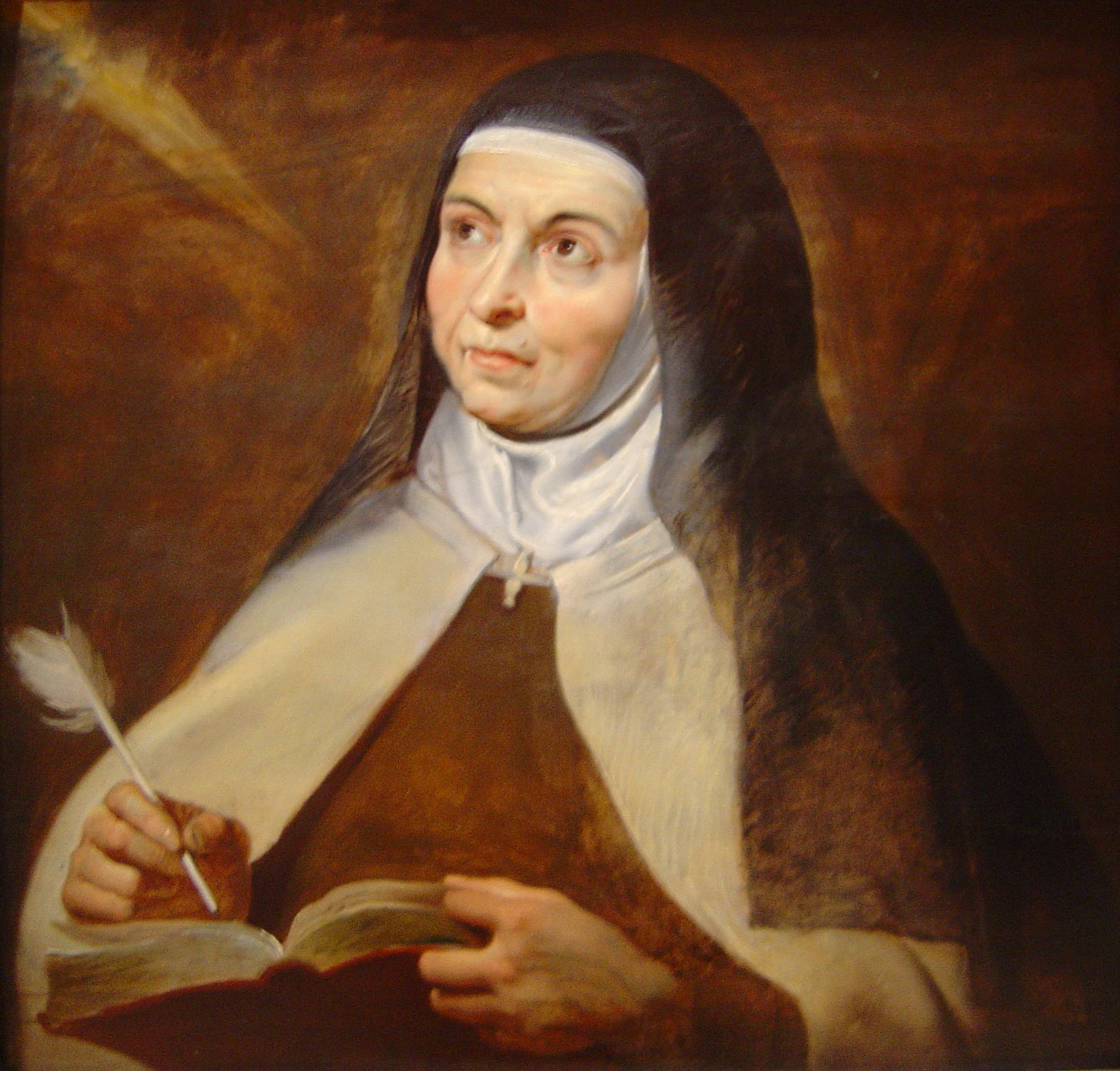
Teresa of Avila and the role of women teachers in the church

Rowan Williams wrote his book before the Church of England had determined that God was calling women to be Bishops in the church. This is the background for his reflection here at the end of his book on Teresa, one of only two women who have the title Doctores Ecclesiae, Doctors of the Church, in the Roman Catholic tradition.

“Christ gives spiritual understanding where he wills (S 1.2), even where this understanding is not the kind bound up with the (male) vocation of teaching and preaching; and even so, one of the trials of the sixth mansions for a woman is the longing to communicate what is understood. ‘She has great envy of those who have the freedom to cry out and spread the news abroad about who this great God of hosts is’ (C VI, 6.3). Thus the egalitarian action of God honouring the friends of God stands in tension with facts in Church and society that Teresa believed to be simply given. God’s practice is to be witnessed to, therefore, in the construction of a community that both is and is not part of the Church’s structure: it is obedient to the discipline of the Church, but because its members are in any case outside the power system of the Church, as women, they have the rather paradoxical freedom to display the priorities of the gospel in a simpler way.

Teresa is thus an eloquent witness to essential elements of internal conflict in Christian tradition. She does not want to overthrow the continuity of the Catholic Church, to reinvent it or recover a more authentic pattern for it as a whole; she has no conception of what the Reformation is about. But she is nonetheless conscious of the gospel narrative – and the narrative of God’s whole ‘mission’ in creation, of which this is a part – as providing some critical perspectives on the Church’s contemporary reality. On the place of women in the twentieth-century Church, Teresa has no conclusions to offer. We live in a situation in which far less is taken for granted about women, and in which a radicalized religious life is no longer the only obvious way of witnessing to the freedom of the gospel in the Church.  But, by expressing in her struggles for a particular kind of community her own sense of the questions put by the practice of Jesus to the assumptions of Church and society, she keeps those questions vividly present to later generations – more vividly than if she had raised the issue of ‘the status of women’ in a coherent theoretical way.”

Teresa of Avila: A Contemplative in Action

One more wonderful insight from Rowan Williams’ study of Teresa of Avila:

“To be actively in the world and at the same time wholly exposed to the reality of God is something most of us cannot imagine: we use activity as a defence against exposure to God; or we use the claims of God (as we see them) as a defence against the risks of action and apostolic faithfulness in a ‘world in flames’ . That life which fuses these inseparably together is Christ’s.”

teresa of avila

Trust the Music of Time

From Hans urs von Balthasar’s Heart of the World: 

Trust Time. Time is music, and the space out of which it resounds is the future. Measure by measure, the symphony is created in a dimension that invents itself, and which at each moment makes itself available from an unfathomable store of Time. Space is often lacking: the stone is too small for the statue, the town-square cannot contain the multitude. When has Time ever been lacking? When has it run out like too short a piece of string? Time is as long as grace. Entrust yourself to the grace of Time. You cannot interrupt music in order to catch and hoard it. Let it flow and flee, otherwise you cannot grasp it. You cannot condense it into one beautiful chord and thus possess it once and for all. Patience is the first virtue of the one who wants to perceive. And the second is renunciation. For look: you cannot grasp the melody’s flight until its last note has sounded. Only now, when the whole melody has died away, can you survey its mysterious balances, the arcs of tension and the curves of distance. Only what has set in the ear can rise in the heart. And therefore (and yet!), you cannot grasp invisibly in the unity of the spirit what you have not sensibly experienced in the manifoldness of the senses. And so the eternal is above time and is its harvest, and yet it comes to be and is realized only through the change of time.

Pierre Teilhard de Chardin on patience

And yet it is the law of all progress

that it is made by passing through some stages of instability

-and that it may take a very long time.

And so I think it is with you;

your ideas mature gradually-let them grow,

let them shape themselves, without undue haste.

Don’t try to force them on,

as though you could be today what time

(that is to say, grace and circumstances acting on your own good will)

will make of you tomorrow.
Only God could say what this new spirit

gradually forming within you will be.

Give Our Lord the benefit of believing

that his hand is leading you,

and accept the anxiety of feeling yourself

in suspense, and incomplete.

Teresa of Avila on being at home with ourselves and God

From the end of the fourth chapter of Rowan Williams’ book on Teresa:

‘It is only when God has been able to love us in fullness that we are wholly there … Only when we are God-filled are we truly human.’ Until we reach God we are discontented with ourselves, our limitations, the duration of time, the pressure of our bodies: the paradoxical conclusion of the Castle is that union with God-the wholly and sovereignly ‘unworldly’, the utterly free and different – is the only thing that will stop time and mortality and the flesh feeling alien or insulting or frustrating. It is as united with God that we learn to be where we are in the world.

On the dangers in supporting our friends when they have been treated unjustly: Rowan Williams in his book on Teresa

“Proper love in community involves deep sympathy with the real needs of others (7.5-6), and we must not be nervous of the ‘natural tenderness’ stirred by this, so long as it does not become the kind of sentimental partisanship that destroys corporate life. This is why it is important not to sympathize with self-pity or self-justification. Teresa’s chapters on detachment and humility lay a good deal of emphasis on bearing unfair accusations patiently, and she insists that it is no sign of friendship to encourage the self-righteous resentment of someone who (rightly or wrongly) believes herself to be suffering unjustly. Our greatest practical service to each other in community is, for Teresa, the mutual destruction of that sense of ‘honour’ which the very existence of the reformed Carmel is meant to challenge; and so the refusal of sympathy over slights and even slanders is of considerable importance. We are to be consistently helped to find our honour in the friendship of God.”